claude-analytic: See Where Your Claude Code Tokens Actually Went
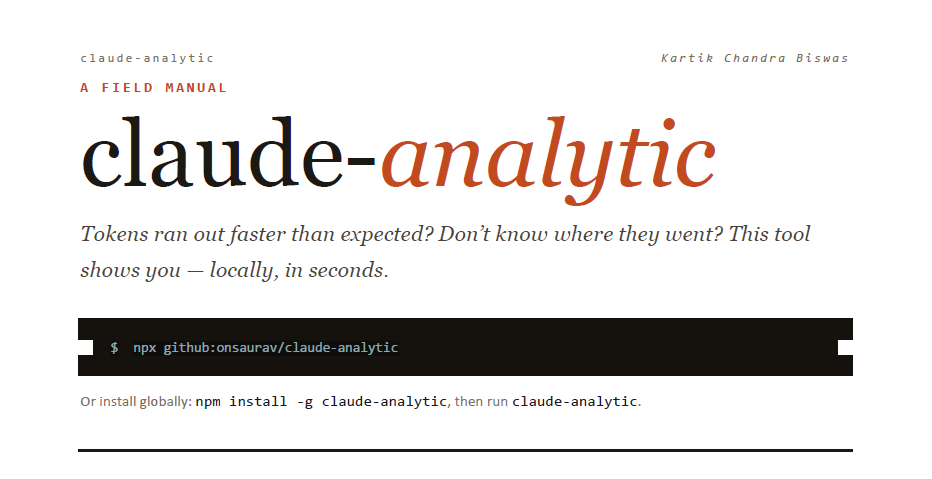
Tokens ran out faster than expected? Don’t know where they went? This tool shows you — locally, in seconds.
npx github:onsaurav/claude-analytic
Or install globally: npm install -g claude-analytic, then run claude-analytic.
What this actually does
A small CLI that reads your local Claude Code sessions and reports token usage and cache hit rate, so you can see why your quota disappeared. No network calls. No API keys. Everything stays on your machine.
Claude Code stores every session as JSONL files under ~/.claude/projects/. The tool reads those files, tallies tokens by type, computes your cache hit rate, and prints a summary. That’s it.
Two ideas worth knowing
Two terms drive everything below: the token (the unit you’re billed for) and the cache hit (the mechanic that makes long sessions cheap). Internalize these and the rest of the report reads itself.
The token
The smallest unit of text Claude reads or writes — roughly ¾ of a word, or about 4 characters in English. Every prompt you send and every reply Claude returns is measured in tokens, and that’s what you’re billed for.
“Hello, world!” → about 4 tokens · 500-word message → ~650 tokens · medium source file → 1,000–3,000 tokens.
There are four token types, and they’re priced very differently:
| Type | What it is | Price / 1M |
|---|---|---|
| Input | Fresh text you sent to Claude — read from scratch, not pulled from the cache | $3.00 |
| Output | Text Claude generated back to you — generation is the costly half of the loop | $15.00 · 5× input |
| Cache write | Input stored into the prompt cache for reuse on future turns | $3.75 |
| Cache read | Input served from the cache instead of re-processed — this is where savings live | $0.30 · 10× cheaper |
The cache hit
When you keep talking in the same session, Claude doesn’t re-read your earlier messages from scratch — it pulls them from a prompt cache. Each time the cache is reused, that’s a cache hit.
A higher hit rate means you’re reusing context efficiently and paying less. Cache hit rate = cache reads ÷ (cache reads + fresh input).
Where your tokens actually went
Sometimes tokens vanish well before you expected. The usual suspects, ordered by frequency:
| What happened | Why tokens drained |
|---|---|
| Big code generation or refactor | Output tokens cost 5× input — generation adds up faster than people expect |
You ran /clear often | Each clear kills the cache. The next prompts pay full price until the cache warms back up |
| Hopping between many projects | Each project has its own cache. None of them stay warm |
| Long idle gaps between turns | Cache expires. You pay the warm-up again |
| Edited a file Claude read early on | Prefix changed. Everything after the change cache-misses |
Reading your hit rate
A day spent at 90% versus 30% can be a 3–5× cost difference. The number itself tells the story:
- 85%+ — excellent
- 60–85% — room to improve
- < 50% — paying full price
What you’ll see
Run the command and you get two sections: your top spenders, then the totals. Sample output:
 ┌──────────────────────────┐
 │  Claude Analytic Report  │
 └──────────────────────────┘

 Detected Claude path: C:\Users\you\.claude\projects
 Total sessions:       3

 ▶ Top 5 Sessions by Token Usage
 ┌──────────────────────┬─────┬────────┬───────────┐
 │ Session              │ In  │ Out    │ Cache Hit │
 ├──────────────────────┼─────┼────────┼───────────┤
 │ d--workspace-claude… │ 153 │ 28,150 │ 99.99%    │
 │ d--workspace-c160c1… │  69 │ 21,284 │ 99.99%    │
 │ d--workspace-claude… │  50 │ 12,826 │ 99.99%    │
 └──────────────────────┴─────┴────────┴───────────┘

 ▶ Overall Summary
 ┌─────────────────────────────┬───────────┐
 │ Metric                      │ Value     │
 ├─────────────────────────────┼───────────┤
 │ Total Input Tokens          │ 272       │
 │ Total Output Tokens         │ 62,260    │
 │ Total Cache Read Tokens     │ 4,123,997 │
 │ Total Cache Write Tokens    │ 135,468   │
 │ Overall Cache Hit Rate      │ 99.99%    │
 └─────────────────────────────┴───────────┘

 💡 Tip: High cache hit rate = lower cost
Top 5 Sessions by Token Usage — your biggest spenders, ranked, with their individual hit rate.
Overall Summary — totals for every token type and your overall hit rate. Reference pricing per 1M tokens: input $3.00 · output $15.00 · cache read $0.30 · cache write $3.75.
Three habits that save tokens
- Stay in one session. Every
/clearis a cold cache. Resume work where you left it whenever you can. - Put stable context first. The cache matches a prefix — anything that changes early invalidates everything that follows. Stable instructions and unchanging files belong at the top.
- Don’t ping-pong between projects. Each project has its own cache. Quick context-switches in short bursts mean none of them stay warm long enough to pay off.
Privacy
Everything runs locally. No data leaves your machine. No telemetry, no API keys, no network calls.
Free and open source under MIT: github.com/onsaurav/claude-analytic
— a small tool, kept honest.